Tree Removal Burnaby: Costs, Permits & Pricing Guide (2026)
How much does tree removal cost in Burnaby?
Tree removal Burnaby pricing covers everything from the initial assessment to cutting, cleanup, and disposal. Typical invoices include labour, equipment, disposal and any permits required by the City of Burnaby. Prices vary because tree size, site access, health, species and local rules each affect the crew, time and gear needed to complete a safe removal.
At Silverback Treeworks, we’re transparent about pricing — our day rate for a 3-person crew with truck and chipper is approximately $3,000. This gives Burnaby homeowners a realistic baseline when comparing tree removal services.
This guide breaks down the factors that drive tree removal Burnaby costs, shows realistic scenarios and ranges to help homeowners estimate expenses, and explains when permits or extra services — like stump grinding — add to the bill. You’ll also learn why hiring certified arborists matters and how Silverback Treeworks’ free video-quote option speeds up an accurate estimate. Keep reading for quick reference tables, local permit steps and a prep checklist to get a reliable quote.
Key factors that change tree removal cost in Burnaby
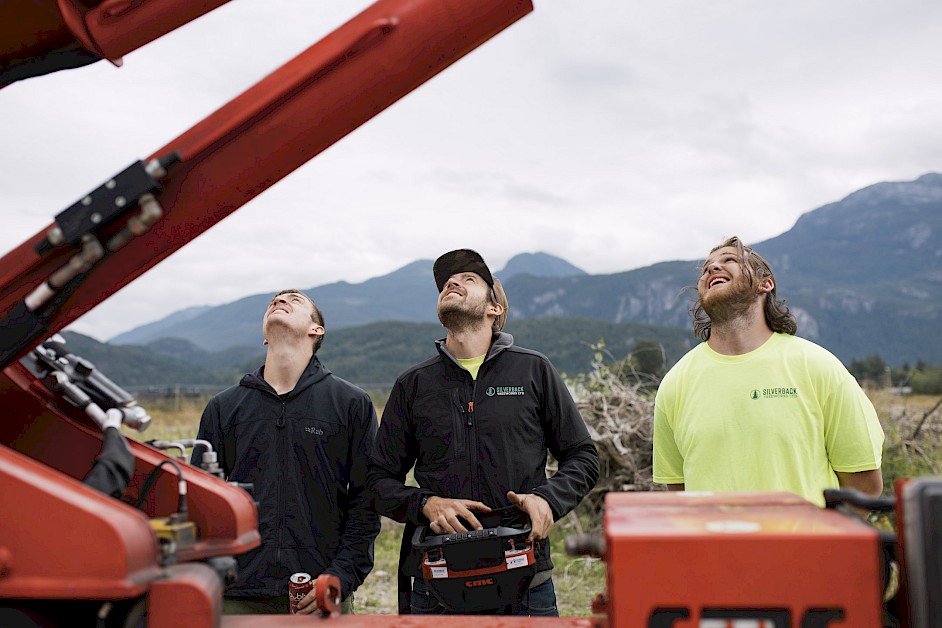
The biggest drivers of tree removal cost are tree size and height, access and location, the tree’s condition and species, permit requirements, and the equipment and labour required. Bigger trees mean more crew time and heavier gear; tight access or trees near structures demand controlled dismantling or lifts; and diseased or unstable trees require extra safety measures and insurance coverage. Those variables combine into scenario-based pricing — a small, open-site removal costs very differently from a large, overhanging tree that needs a crane. Knowing these factors helps homeowners decide whether to request a remote estimate, a formal quote, or an on‑site assessment.
Quick summary of the main cost drivers before we dive into examples and tables:
- Tree size and height determine crew size, equipment and total time on site.
- Accessibility and proximity to buildings influence rigging, protection and safety measures.
- Tree condition and species affect risk, disposal complexity and permit triggers.
These core points set up the next sections, which unpack size, access and condition with practical examples and ranges.
How tree size and height influence pricing
Size and height define the scope of the work: trunk diameter, crown spread and vertical reach determine the crew, tools and time required. Large trunks often need sectional dismantling, cranes or lifts and more labour to lower cut pieces safely; small trees are usually removed faster with hand tools. Bigger trees also create more debris to chip or haul, which increases cost. For example, a tall cedar near a home will be sectioned and removed more slowly than a small maple in an open backyard. Knowing size categories helps homeowners estimate whether a job is basic, complex or specialist.
Quick reference table mapping size to crew, equipment and typical cost band for Burnaby jobs.
Tree Size Category | Typical Diameter / Height | Crew & Equipment Needed and Estimated Cost Range |
|---|---|---|
Small | Diameter under 30 cm / Height under 8 m | Two-person crew, chainsaw work, chipper; typically falls in the lower-cost band for straightforward removals. |
Medium | Diameter 30–60 cm / Height 8–15 m | Three-person crew, small lift or rigging, chipper and truck; usually a moderate-cost job. |
Large | Diameter over 60 cm / Height over 15 m | Multi-person crew, crane or spider lift, advanced rigging and traffic control; typically in the higher-cost band. |
This table shows how small increases in size translate to larger equipment needs and higher Burnaby removal estimates — next we’ll look at access issues.
Why location and accessibility change costs
A tree’s position on the property affects safety and logistics. Trees close to houses, fences, power lines or on steep slopes need extra protection, controlled cuts, and sometimes lifts or cranes to avoid damage — all of which add equipment and operator time. Tight gates, narrow lanes or limited parking can force crews to break tasks into smaller stages or use smaller equipment that takes longer to operate, increasing labour hours. Trees near utilities may require coordination with service providers, adding time and potential fees.
Combine a large trunk with poor access and the job often moves into a higher-cost band because of the slower, more careful dismantling and added protective measures; we discuss condition and species next for the final cost drivers.
How tree condition and species affect removal pricing in Burnaby
Health and species change how crews remove a tree. Diseased, hollow or compromised trees require tag lines, staged dismantling and extra personnel to prevent unpredictable collapse — increasing labour and time.
Species with dense wood or heavy limbs produce larger, heavier pieces that need bigger equipment and safe hauling. Brittle species raise the risk of sudden breaks and slow the work.
Indicators that commonly increase complexity and cost:
Visible decay, fungal growth or hollow sections
- Significant lean, root heave or large co-dominant stems
- Excess deadwood, storm damage or pest infestations
- These signs typically add safety steps and crew resources.
How tree health increases removal complexity and price
Unhealthy trees are riskier to remove because weakened structure increases the chance of sudden failure. An arborist’s assessment looks for rot pockets, root decay and canopy imbalance; each finding can add rigging, more personnel and elevation equipment to manage the risk. Unstable trees may also require special insurance or administrative steps, which show up in the final quote. In practice, a medium-sized tree with severe decay can cost as much to remove as a larger, healthy tree because of these precautions.
Knowing these risk signals helps homeowners decide between a standard scheduled removal and an urgent or emergency response.
Do specific species affect removal costs in Burnaby?
Yes. Species matter because wood density, branching habits and root systems change cutting strategy and disposal handling. Dense hardwoods create heavier logs that need larger equipment and more manpower, while brittle species increase the chance of unpredictable breakage and slower, more cautious work. Some species also produce disposal challenges (large root masses or bulky coarse wood), which affects hauling and chipping time. Local protection rules may also apply to certain species — see the permit section below.
Species-driven differences are one part of permit triggers and legal considerations that can add time and fees.
When do you need a tree removal permit in Burnaby — and how does it affect cost?
Permit requirements in Burnaby depend on trunk diameter, whether the species is protected, and the tree’s location relative to environmentally sensitive areas. If a permit is required, expect application steps, potential fees and processing time that increase the total project cost and may delay scheduling. Typical triggers include trees above a certain diameter at breast height, trees in regulated areas or protected species. Meeting those triggers usually means submitting documentation and sometimes an arborist’s report. Permit processing can also require mitigation planting or inspections that add to the scope and cost.
Common permit triggers and their immediate impacts on cost and schedule:
- Diameter threshold — a formal application and measurements add administrative cost and time; in Burnaby, a Tree Cutting Permit is required for any tree greater than 20 cm (8 inches) in diameter. (burnaby.ca)
- Protected species or conservation zones — species verification and mitigation plans typically require arborist input and increase project cost. (burnaby.ca)
- Trees near streams or heritage areas — additional approvals and longer review times can expand timelines and costs.
These permit triggers feed directly into the application steps described next so homeowners can prepare before requesting a quote.
What Burnaby permit requirements should you expect?
Permits usually hinge on a diameter threshold, protected-species status and whether the tree sits in a sensitive area. Homeowners should measure diameter at breast height or consult an arborist to confirm whether a permit is needed. Applications often require a site plan, photos and, in some cases, a replacement planting plan or an arborist report — each adds administrative time and potential inspection fees. Checking permit rules up front prevents surprises and keeps the final Burnaby tree removal estimate aligned with legal compliance.
Concise table mapping triggers to typical requirements and likely cost/timeline impact:
Permit Trigger | Requirement / Condition | Impact on Cost / Timeline |
|---|---|---|
Diameter threshold | Formal application and measurement documentation | Adds application time and possible fee; may delay scheduling by weeks if approval is needed |
Protected species | Species verification and mitigation plan | Requires arborist input and replacement planting that increase cost |
Environmentally sensitive area | Additional approvals and inspections | Longer review times and possible conservation conditions that raise project scope |
This table shows how permit triggers translate into concrete steps and likely extra costs; the section below explains the application workflow.
How to apply for a tree removal permit in Burnaby
Applying for a Burnaby permit follows a few clear steps: check whether the tree meets permit thresholds, gather required documents, submit the application with photos and measurements, and wait for review and any site inspection. Required items commonly include a site plan showing the tree’s location, diameter measurements, clear photographs and an arborist report when the tree’s health or significance is in question. Common pitfalls include missing measurement details or failing to propose mitigation planting when required. Timelines vary, so plan for multiple weeks between submission and approval to avoid rushed removals.
If you prefer, Silverback Treeworks can manage the entire Burnaby permit process on your behalf, including measurements, documentation and application submission.
Use this checklist to prepare a complete application:
- Measure trunk diameter at breast height and document the tree’s location with a simple site plan and clear photos.
- Obtain an arborist report.
- Complete the city application form and attach required documents; allow time for processing and inspection.
For more details, see our Burnaby tree permit page.
Additional services that affect total tree removal cost in Burnaby
Line items such as stump grinding, full stump removal, wood chipping and hauling, emergency callouts and pruning add to the base removal price. Bundling services (for example, grinding the stump during the same visit) can often lower the combined cost compared with separate visits, while emergency responses usually carry surcharges for rapid mobilisation and hazard management. Understanding common add-ons and their typical ranges helps homeowners decide what’s essential and what’s optional.
Table summarizing common add-ons, typical time/equipment and expected additional cost impact for Burnaby jobs.
Service | Typical Time / Equipment Required | Additional Cost Range |
|---|---|---|
Stump grinding | Stump grinder, 30–90 minutes depending on diameter | Moderate additional charge based on stump size and access |
Wood chipping / hauling | Chipper, truck haul-out, several hours | Additional cost scales with volume and distance to disposal site |
This table helps quantify how each add-on can increase the final invoice; the sections below give more detail on stump work and emergency services.
Stump grinding: what to expect on cost
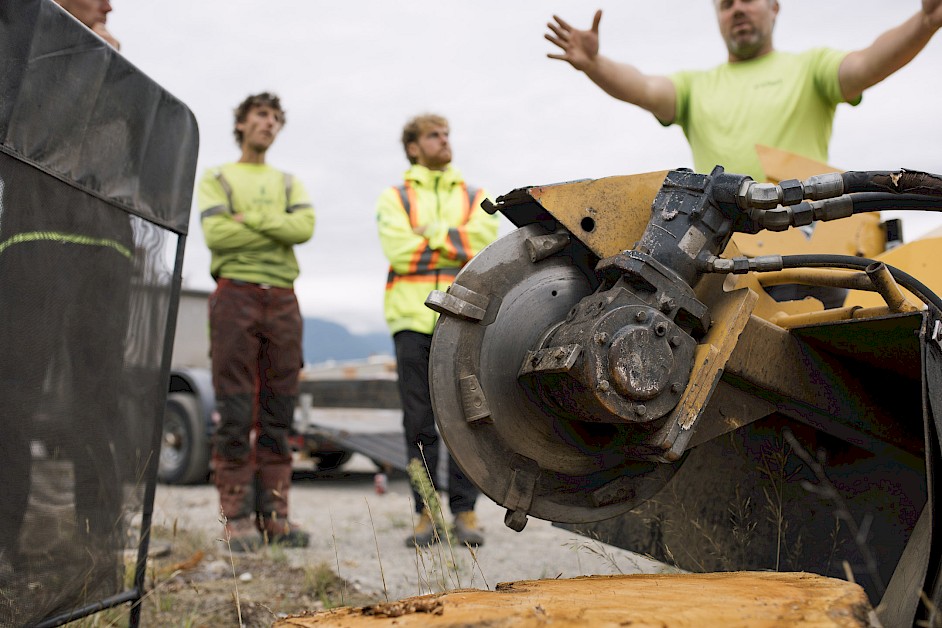
Stump grinding cost depends mainly on stump diameter, depth and access. Small, accessible stumps take less time and usually fall into a lower price band; large stumps near structures or on slopes require extra precautions and longer machine time, raising cost. Full stump removal (excavation) is considerably more expensive because it involves digging, root removal and soil replacement. Scheduling stump grinding at the same time as the removal often reduces mobilization fees and gives a better combined price than separate visits.
When to grind vs remove:
- Stump grinding is usually the best choice to remove the visible trunk, reduce tripping hazards and leave most soil intact.
- Full stump removal is required when regrading, new planting or construction needs complete root extraction and a level site.
- Bundling stump grinding with the initial tree removal often lowers total labour and equipment mobilization costs.
These choices determine whether Burnaby removal costs stay modest or rise because of excavation and disposal needs.
Emergency removals and urgent pruning — how pricing differs
Emergency tree removal and urgent pruning are priced at a premium because crews must respond quickly, often outside regular hours, and perform higher‑risk work under time pressure. Emergency calls involve rapid mobilisation, possibly specialist crews trained for dangerous scenarios, and immediate site stabilisation — all of which increase labour rates and may include off‑hours surcharges. Routine pruning and scheduled removals are usually more cost‑efficient because they’re planned. If you’re unsure whether a situation is an emergency, get a quick arborist assessment before authorising removal to ensure the right response and accurate billing.
Quick guidance for emergency vs scheduled work:
- Call for emergency removal when a tree threatens life, structures, or power lines right now.
- Schedule non-urgent pruning or removal for trees that show decline but pose no immediate collapse risk.
- Request an urgent assessment from an arborist before approving emergency work to confirm the correct solution and billing.
Knowing emergency pricing helps homeowners balance safety needs against higher short-notice costs.
Why hire ISA Certified Arborists for removals in Burnaby?
ISA Certified Arborists bring proven training, formal safety practices and technical know-how that reduce risk and improve outcomes on complex jobs. Certification shows familiarity with accepted arboricultural methods, risk assessments and safe rigging and climbing techniques — all aimed at protecting people and property. Certified teams may quote higher rates because of higher insurance and skill levels, but they also reduce the chance of accidents, property damage or rework that can drive up total costs. For Burnaby homeowners who value predictable, safe results, hiring certified professionals is a sensible investment.
Silverback Treeworks uses ISA certified arborists and focuses on safety-first crews, local experience and a practical quoting process that includes a free video-submission option. That approach gives homeowners clear, trustworthy pricing and a plan before any work begins.
How ISA certification improves safety and quality
ISA certification requires arborists to demonstrate knowledge of tree biology, safe work procedures and standard rigging and pruning techniques. Certified professionals perform structured risk assessments, select appropriate cutting methods and set up fall protection and exclusion zones to safeguard people and hardscapes. These controlled methods may cost more up front but reduce the chance of incidents that lead to larger expenses later, like structural repairs or insurance claims. Homeowners also gain documented safety plans and professional accountability with certified crews.
Because certified teams use formal protocols and documentation, they can often streamline permit coordination and inspections, which supports clearer estimates and more predictable timelines.
Which specialized equipment and insurance items affect cost?
Equipment such as cranes, spider lifts, chippers, stump grinders and traffic‑control materials adds rental and operator fees to Burnaby removal quotes. The need for those items is driven by tree size, placement and risk. For instance, crane or lift rentals include hourly rates, certified operators and rigging crews, which can substantially raise daily costs but are essential for safe work near structures. Enhanced insurance and liability coverage for high‑risk removals also affect contractor operating costs and may be reflected in higher quotes. Understanding these drivers helps homeowners recognise which costs are necessary safety investments and which are optional conveniences.
When specialised gear or extra insurance is typically required:
- Use cranes or spider lifts when sections cannot be safely lowered by rope or sectional dismantling alone.
- Deploy chippers and haul trucks when debris volume demands on‑site processing and rapid removal.
- Expect higher insurance-related costs for work over structures, roadways or critical infrastructure.
Accepting these triggers helps homeowners see that some costs are non‑negotiable safety measures rather than discretionary extras.
How to get an accurate tree removal quote in Burnaby
The most accurate Burnaby removal estimates come from clear site information — photos or video that show size, access and condition — plus a contractor’s review of permit needs and optional services. Remote video assessments often produce a reliable initial estimate when on‑site visits aren’t practical, but complex or high‑risk jobs usually still need a site visit to finalise pricing. Provide clear measurements, show all approach routes, document nearby structures and utilities, and flag any permit or conservation concerns to reduce surprises and align a contractor’s quote with your needs.
Silverback Treeworks Ltd. offers a free video submission process: record short footage from multiple angles, include a measuring reference and nearby structures, then submit it for an initial estimate or a recommendation for an on‑site visit. This workflow speeds initial pricing while keeping accuracy for most Burnaby removals.
How the free video-quote process works
With the free video-quote option, homeowners capture a short set of views that document size, access and nearby constraints so an arborist can make an informed initial assessment. Useful footage includes a full-crown sweep from several sides, a trunk shot at breast height with a measuring reference, shots of gates and access routes, and close-ups of any decay or damage. The arborist reviews the clips to decide whether a remote estimate will suffice or if a site visit is required for high‑risk removals. This saves time and helps prioritise in‑person visits for the most complex jobs.
Video tips to get the most accurate remote estimate:
- Record a 360° sweep of the tree, show a measuring stick or tape at chest height, and include nearby buildings or fences for scale.
- Capture access paths, gates and obstacles, and film close-ups of rot, cavities or structural defects.
- Narrate or annotate the video with any history, recent storm damage or known utility lines that affect the job.
Following these tips increases the chance of a useful initial Burnaby removal estimate without waiting for an immediate site visit.
Frequently asked questions
What should I check before hiring a tree removal company in Burnaby?
Check the company’s experience, certifications and insurance. Look for ISA Certified Arborists and ask for proof of liability coverage. Read reviews and request references. Confirm the services included (stump grinding, cleanup, hauling) and get a detailed written quote that lists potential extra costs. That due diligence helps you choose a reputable crew that matches your needs.
How can I tell if my tree needs to be removed?
Signs a tree may need removal include visible decay, major leaning, large dead branches or extensive storm damage. If the tree threatens structures or power lines, removal may be the safest option. A certified arborist can inspect the tree and recommend removal, pruning or treatment to extend its life.
What environmental issues should I consider with tree removal in Burnaby?
Consider impacts on local wildlife, soil and the neighbourhood canopy. Some species are protected and require permits; removal can affect air quality and local microclimates. Discuss replanting or mitigation with your arborist and check local regulations to ensure responsible, compliant tree management.
Do seasonal factors change tree removal costs?
Yes. Demand often peaks in spring and fall, which can raise prices. Winter work may sometimes be cheaper because frozen ground reduces site damage, but poor weather can increase safety concerns and costs. Scheduling work in off‑peak times can save money when practical.
What are the risks of DIY tree removal?
DIY removal risks serious injury, property damage and possible legal trouble if permits are required. Without training and proper gear, homeowners may misjudge stability or miss nearby hazards. Hiring a professional arborist ensures safe methods, regulatory compliance and correct disposal.
How should I prepare for a tree removal consultation?
Gather clear photos and a short video, measure trunk diameter, note access routes and nearby utilities, and list your desired outcome for the tree and stump. Bring any existing permit paperwork. This information helps the arborist give an accurate assessment and quote.
What happens after a tree is removed — what about site restoration?
After removal, contractors typically clean debris, grind or remove the stump and address soil disturbance. Depending on your agreement, they may fill and level the hole left by the stump. Many homeowners choose to replant or landscape the site; discuss restoration and wood reuse options with your arborist during the consultation.
Conclusion
Understanding the factors that affect tree removal costs in Burnaby — size, access, condition, species and permits — helps homeowners make clear, informed choices. Plan ahead, gather measurements and photos, and use Silverback Treeworks Ltd.’s free video-quote option to speed a reliable estimate. When safety and property protection matter, choosing experienced, certified arborists for your tree removal Burnaby project brings predictable results and peace of mind.
Need tree removal in Burnaby? Get a free video quote from Silverback Treeworks today.